

Key takeaways
- There's no fixed regas interval. Check every vehicle before summer and regas only where a test says so.
- Cool rather than cold air, slow cool-downs and oily AC fittings are common signs of low gas.
- Regassing without fixing the leak means paying for the same gas twice.
- Book the fleet in for a pre-summer check, in batches at your depot or yard.
The honest answer: there's no fixed interval
Ask around and you'll hear every two years, every three years or every summer. None of those numbers holds up across a whole fleet. Vehicle AC is a sealed system, so it isn't meant to use gas the way an engine uses fuel.
What matters is whether each vehicle is still holding its charge and cooling properly. A ute that sits in the yard most of the week and a tipper doing long, hot days out of Singleton won't wear at the same rate. Start with the service schedule for each model and follow any AC items the maker lists.
Beyond that, skip the calendar. Check every vehicle once a year before the heat, and regas only where a test says it's needed. That way your money goes on the vehicles that are actually low, not across the board.
Signs a vehicle is low on gas
Drivers and operators usually notice first, so ask them. Write down which vehicles they complain about and what they say, because the details help whoever does the testing. These are the usual giveaways:
- Air that's cool rather than cold, especially at idle or crawling through roadworks
- A cab that takes much longer to cool down than it used to
- The compressor clicking in and out more often than normal
- Oily residue on AC hoses, fittings or the compressor body
Why a regas without finding the leak wastes money
None of those signs proves the gas is low. A blocked condenser, a failing fan, a slipping belt or an electrical fault can feel exactly the same from the driver's seat. Regas a vehicle with one of those problems and you've paid for gas it didn't need.
If the system really is low, the gas has gone somewhere. Refill it without finding the leak and the new charge heads out the same way. You pay for gas and labour again, and the vehicle comes off the road again.
Running low is hard on the compressor as well. The refrigerant carries the oil that lubricates it, so a short charge can leave the compressor starved. Replacing a compressor usually costs far more than fixing a leaking hose or seal.
There's a rule behind this, too. The Australian automotive code of practice that licensed technicians work to says a system must not be topped up, and must not be regassed while there's doubt about its integrity. A leaking system gets repaired, or the owner is told it should be decommissioned.
What a proper AC check involves
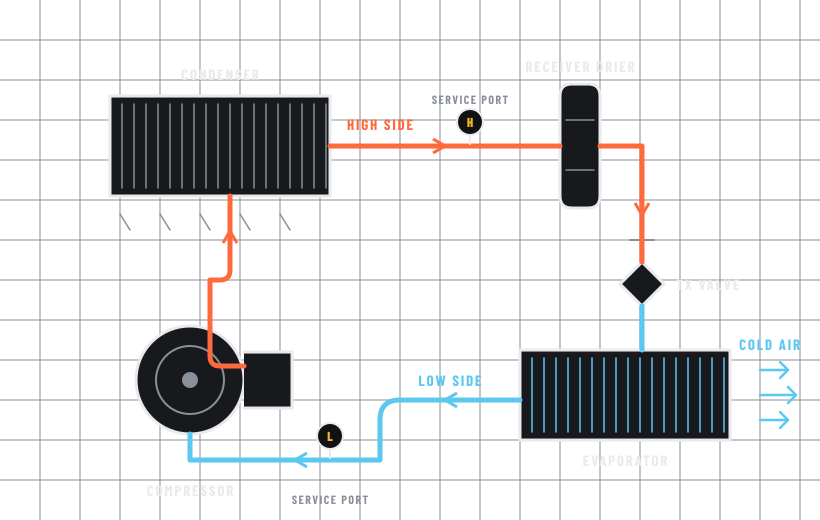
A proper check starts with testing, not filling. The tech inspects and leak tests the system, checks pressures and the temperature at the vents, and looks over the condenser, fans, belts and hoses.
If gas is needed, it's done in order: recover what's left, pull a vacuum, confirm the system holds, recharge to the maker's specified amount, then run a performance check. Because the system is emptied and refilled to spec, you know exactly what's in it.
Afterwards, look for the service label. The code requires a durable label after every AC service, showing the business and technician who did the work, the technician's licence number, the date, and the refrigerant and oil in the system. It also tells you at a glance which vehicles run R134a and which run R1234yf.
Check before summer, and do the fleet in batches
The worst time to find a dud system is the first week of real heat, when you're competing with everyone else for an AC tech. Late spring gives you time to fix leaks properly instead of rushing a regas to get a vehicle back out.
If your vehicles come back to a depot or yard, have them checked there in batches rather than sending them out one at a time. Drivers stay on the job, nobody sits in a waiting room, and the whole fleet is checked the same way.
Give the tech a list with driver complaints noted against each vehicle, and have keys ready. The ones already blowing warm go first. Our pre-summer AC checklist covers the prep in more detail.
Quick answers
Is it normal for a vehicle to need a regas every summer?
Not for a system in good condition. If the same vehicle needs gas every year, it's losing it somewhere. That leak should be found and repaired rather than refilled again.
Can you just top up the gas?
No. The code of practice licensed technicians follow rules out top-ups. The system is recovered, vacuumed, leak tested and recharged to the specified amount instead, so you know the charge is right.
Do you work on private cars?
No, sorry. We only work on business vehicles, fleets and machinery, and we come to your depot, yard or worksite.
Sources
- The Australian automotive code of practice for the control of refrigerant gases in motor vehicle air conditioners (2008)
- Australian Refrigeration Council: licence conditions and standards as of 20 February 2025
- Australian Refrigeration Council: Fact sheet 4, automotive air conditioning licence
- Professional Motor Mechanic: What are the key faults that can cause vehicle compressor failure?