

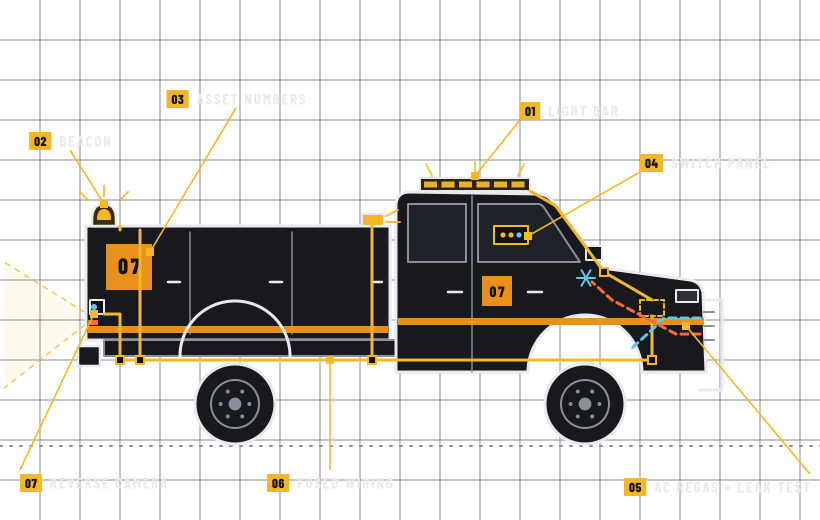
Key takeaways
- Get every site's and client's vehicle requirements in writing before you buy parts.
- Size the second battery to what runs with the engine off.
- Build one vehicle as the pattern, then copy it across the fleet.
- Book builds in batches so crews are never short of vehicles.
Start with what your sites and clients ask for
Before anyone orders a light bar, find out what your sites and clients expect to see on your vehicles. Some have their own requirements for vehicles that come on site, covering things like beacons, reversing alarms, cameras and markings, and they don't always line up. Get them in writing from every client you regularly work for.
Then compare them. If one client wants something the others don't, it's often cheaper to build every vehicle to the highest common spec than to run a fleet where some vehicles can only go on some jobs.
Requirements change, too. When a contract is renewed or a new site comes on board, check whether the vehicle spec has moved before the next batch of builds, not after.
Lights: be seen, and see the job
Beacons and light bars only help if they can be seen, and work lights only help if they light the job. Check these before any brackets go on:
- Mount beacons or the light bar high, where roof racks, ladders and loads can't hide them.
- Add lower lights front and rear if anything up high is likely to be blocked.
- Set flash patterns so the lights work together rather than looking random.
- Aim work lights at the work area, not into the eyes of oncoming drivers, and add a switch at the tailgate so the crew can run them from the tray.
- Sit in the cab in the dark with everything running. Glare off the bonnet or back into the mirrors gets tiring fast on an early start.
Cameras and the switch panel
Treat a reverse camera as part of every build, mounted where the tray, towbar and any load don't block its view. A second camera covering the tray or rear work area lets the driver see who's at the tailgate before moving off. If you're weighing up cameras that detect people and alert the driver, read how AI camera detection works before you spec it.
The switch panel goes where the driver can reach it without leaning or looking away for long. Label every switch, make sure the labels can be read at night, and group them by job: warning lights together, work lights together, cameras and accessories beside them.
Wiring, fusing and battery capacity
This is where rushed fit-outs fall over. Every circuit should be fused close to its power source, so a short anywhere along the run blows the fuse instead of cooking the cable. High-draw gear should run through relays, with the panel switches only triggering them.
Cable needs to be sized for the load and the length of the run, joins crimped and sealed, and every pass through a panel or chassis rail protected by a grommet. Keep the fit-out off factory wiring where you can, because tapping factory circuits is a reliable way to create faults that come and go. A dedicated fuse and relay box, with a labelled fuse map in the glovebox, saves time on every job after that.
For battery capacity, list everything that runs with the engine off and for how long: beacons, work lights, cameras, radios, fridges and chargers. That total sets the size of the second battery. Run the fit-out from that battery rather than the start battery, with a low-voltage cut-out so a long shift never ends with a ute that won't start.
Many late-model utes have smart alternators that vary their output, so a DC-DC charger is often the better way to keep a second battery charged. If drivers are idling for hours just to keep the gear running, the battery set-up is too small.
Mounting and payload
Everything bolted to a work ute has to survive years of corrugations, potholes and site tracks. Brackets and frames should be built for that, and placed where they won't foul the tray, the canopy doors or the load. A light that shakes loose takes its wiring with it.
Weight creeps up, too. Add up the canopy, drawers, racks, toolboxes, second battery and the gear the crew carries against the ute's payload before you lock in the build.
Signage, asset numbers and one layout for the fleet
Lock in the artwork and positions before the build: company branding, asset numbers and any wording your client asks for. Signage goes on last, once lights and brackets are fixed, so nothing ends up drilled through or hidden. Choose asset numbers that can handle the wash bay, too, or you'll be replacing them before long.
Then build the first vehicle as the pattern. Have a supervisor and a couple of experienced drivers go over it, change what needs changing, and build the rest to match. Record it all: parts list, switch layout, fuse map, wiring diagram and photos.
Do that and any driver can jump in any vehicle before dawn and find the right switch by feel. One shelf of spares covers every vehicle, and fault finding is quicker because they're all wired the same way.
Plan the downtime
Order parts before the vehicle comes off the road, not after. Have new vehicles fitted out before they go into service, and book builds in batches that leave enough utes for the week's work.
We do fleet vehicle fit-outs on utes, vans and trucks at your depot or yard: beacons, light bars, cameras, switch panels, wiring and battery upgrades. We also do signage and asset numbers, including our own Respro numbers that stand up to high-pressure cleaning. Tell us your clients' requirements and we'll build to them, with weekend work by arrangement if weekdays are too tight. If your fleet has drifted into several different layouts, we can help you settle on one.
Quick answers
Can you match the layout of our existing vehicles?
Yes. Show us one of your current vehicles or a build sheet and we can match it, so new builds don't add another variation to the fleet. If something in the current set-up is causing problems, we'll point it out before we copy it.
Do we need a second battery?
If anything runs for long with the engine off, usually yes. Add up what runs and for how long. If that's more than the start battery can spare, a second battery with its own charging is the more reliable way to go.