

Key takeaways
- It warns the operator. It doesn't replace separation, exclusion zones or spotters.
- It's most useful where blind spots and people on foot mix.
- Dust, glare, rain and dirty lenses all matter, so test it in real site conditions.
- A good install starts with the blind spots and finishes with a walk test.
How it works
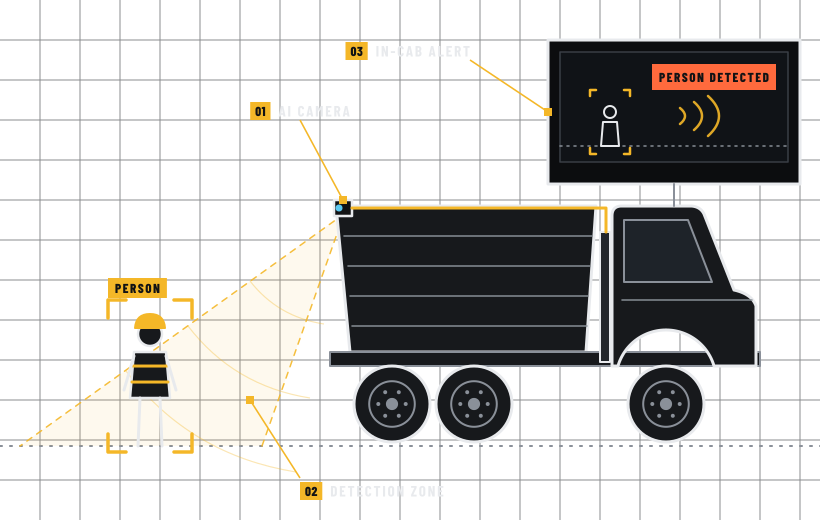
The basic set-up is one or more cameras on the vehicle or machine, running software trained to recognise people. When it picks out a person inside a zone you've set, it alerts the operator with a sound, a light or a warning on a screen.
Proxicam, the system we supply and install, is a good example. Its cameras do the processing on board, with no separate control box, and up to four of them can cover one machine. Proxicam says its AI picks out people whether they're standing still or moving, and it quotes 99.8% detection accuracy.
That's the difference from a plain reversing camera, which only helps if the operator happens to be looking at the screen. It also differs from tag-based systems, which rely on every person on foot wearing a tag. Proxicam doesn't need RFID tags or special vests.
Where it helps
Detection earns its place where people and machines share space and the operator can't see everything. Reversing is the obvious case. SafeWork SA's August 2025 alert on mobile plant and pedestrians lists audible and visual alerts, such as reversing alarms and flashing lights, among its controls, and says to design site layouts that cut down plant movement and reversing.
These are the jobs where it makes most sense:
- Reversing trucks: tippers and rigid trucks backing into tight sites, where the space behind the truck is hard to see.
- Loaders in yards: constant forward and reverse cycles, trucks coming and going, and people walking between stockpiles, the office and the weighbridge.
- Plant near ground crews: excavators slewing beside pipe crews, and rollers and graders working close to labourers.
- Busy depots: forklifts and trucks sharing a yard with people on foot.
What it doesn't replace
An AI camera is an extra layer, not the plan. SafeWork NSW's alert on working around mobile plant says to eliminate the risk first if you can. That means designing the workplace so vehicles and pedestrians are separated, or scheduling work so they aren't in the same area at the same time.
Where that isn't possible, the alert says to plan how vehicles and people move around the site, train the people involved, and use controls such as barriers and exclusion zones, audible and visible alarms on moving plant, spotters, restricted access and hi-vis. It notes that most sites need a combination, and says to keep assessing alternative controls, new technology included.
Proxicam says much the same about its own product. Its guidance calls detection 'a helpful layer' and one part of your overall control stack, and says it doesn't replace separation where that's practicable, or training, supervision and safe work procedures. An alert also only helps if the operator notices it and has time to react, which is why training belongs in the install.
The practical limits
These systems see through a lens, and lenses on plant get filthy. Dust, mud, diesel film and road spray all cut down what a camera can see, so a lens check belongs on the pre-start. Proxicam warns the operator if mud, snow or another covering blocks a camera's view, but someone still has to clean it.
Light and weather matter too. Proxicam's trial checklist asks what happens in dust, glare, rain or condensation, grime, low light and washdown areas. Test any system in the conditions your crews actually work in, not just on a clear morning in the yard.
Coverage has limits as well. A camera only sees what's in its field of view, so where it's mounted decides what's covered. Nuisance alerts are a risk too: Proxicam's article on alert fatigue warns that frequent or poorly aligned alerts can train people to ignore, mute or work around a control.
What a good install involves
A good install starts with the machine and how it's used, not with a box of parts. It should cover:
- Walking around the machine with the operator, sitting in the seat and mapping the blind spots.
- Cameras placed to cover those zones, on solid mounts protected from rocks, branches and pressure washers.
- Power from a properly fused supply, with the harness routed and clamped like any other critical wiring.
- A monitor or alert unit where the operator naturally looks, without blocking the view out.
- Detection zones set for the work, because a loader in a tight yard needs different zones from a truck on a road job.
- A walk test, with someone moving through each zone, standing and crouched, while the alerts are checked.
- Showing every operator what the alerts mean and what the system can't see.
- Agreeing who can change the settings, and recording any changes.
- A recheck after any damage, repair or camera move.
Is it worth it for your fleet?
Start with where people and machines actually mix on your jobs: which machines reverse most, where ground crews work closest to plant, and where your near misses have happened. If you can separate people from the machine, do that first.
Where you can't fully separate them, detection is a sensible extra layer that helps reduce risk. As an authorised Proxicam reseller, we supply, install and set up Proxicam AI camera detection on trucks and plant for civil and earthmoving, mining and plant hire fleets. We'll look at the machine and tell you straight whether it's worth fitting.
Quick answers
Does AI camera detection replace a spotter?
No. It gives the operator an extra warning, but it doesn't replace spotters, exclusion zones or separating people from plant. It's for when those controls are in place and people still end up near the machine.
Does it work at night?
Proxicam says its AI detects people in complex and low-light environments. Lighting varies from site to site, though, so test it on your own site after dark before your crews rely on it.
Can it go on older machines?
Age usually isn't the deciding factor. What matters is solid mounting points for the cameras, a clean power supply and room in the cab for a monitor or alert unit. We'll check those on the machine before you commit.
Sources
- SafeWork NSW: Working with or around mobile plant safety alert
- SafeWork SA: Mobile plant and pedestrians don't mix (August 2025)
- Proxicam: Product page
- Proxicam: Product brochure, v1.8 (PDF)
- Proxicam: Mining safety
- Proxicam: Admin vs engineering controls, where pedestrian detection systems fit
- Proxicam: Before you trial pedestrian detection, a checklist
- Proxicam: Alert fatigue, how to evaluate pedestrian detection without creating new risk