

Key takeaways
- The usual suspects are corroded connections, poor earths and damaged wiring.
- Operator notes on when it happens beat any amount of guessing.
- Voltage drop testing under load finds what a quick check misses.
- Fix the cause and protect the area, or it'll be back.
Why they cost more than a fault that stays broken
A dead circuit gets found and fixed. An intermittent one is working fine when the tech arrives, gets written up as no fault found, and goes back to work until it fails again, usually somewhere less convenient than the yard.
Meanwhile the costs pile up. Every visit is another call-out, and parts get swapped on guesswork: sensors and relays first, sometimes expensive modules. Operators learn to ignore warning lights that come and go, which is the last habit you want in a cab.
Some intermittent faults are only a nuisance. Others knock out the beacons on a service ute, a reversing alarm or a camera, or shut a machine down halfway through a job. Either way, a machine you can't rely on is costing you, even on the days it works.
The usual causes
Often the fault isn't in the part that gets blamed. It's in the wiring and connections around it, and the same handful of causes turn up again and again:
- Corrosion: moisture gets into connectors and terminals, helped along by coastal air and regular washdowns, and builds resistance until the circuit drops out under load.
- Chafed wiring: a harness rubbing on a bracket, chassis rail or hinge point wears through slowly, then shorts or opens when the machine moves a certain way.
- Poor earths: loose or painted earth points, corroded earth straps, or several accessories sharing one tired earth.
- Rushed accessory installs: tapped factory wiring, missing fuses, undersized cable and joins that were never sealed.
- Vibration: loose terminals, connector pins that lose their grip, and wire strands that fatigue and break inside the insulation.
Start with the history
The fastest way to find an intermittent fault is to know exactly when it happens. Ask operators to jot down the time, the conditions and what they were doing every time it shows up, because a week of honest notes can narrow the search more than a day of testing. Before anyone picks up a multimeter, pull together what you already know:
- Stored fault codes, and how often and when they've logged, if the machine records them.
- Operator notes: hot or cold, wet or dry, rough ground, a particular function in use, first start of the day.
- Recent work: new accessories, repairs, a washdown or a part replaced just before it started.
- A photo of the dash or display when the warning shows.
How a good auto electrician tracks it down
With the history in hand, the next step is to make the fault happen on purpose. That can mean warming the machine up, wetting a suspect connector, or flexing the harness where it moves in normal work.
A wiggle test does that section by section. The circuit is monitored live while each part of the harness and each connector is flexed and tapped, and when the reading drops out, you've found the area.
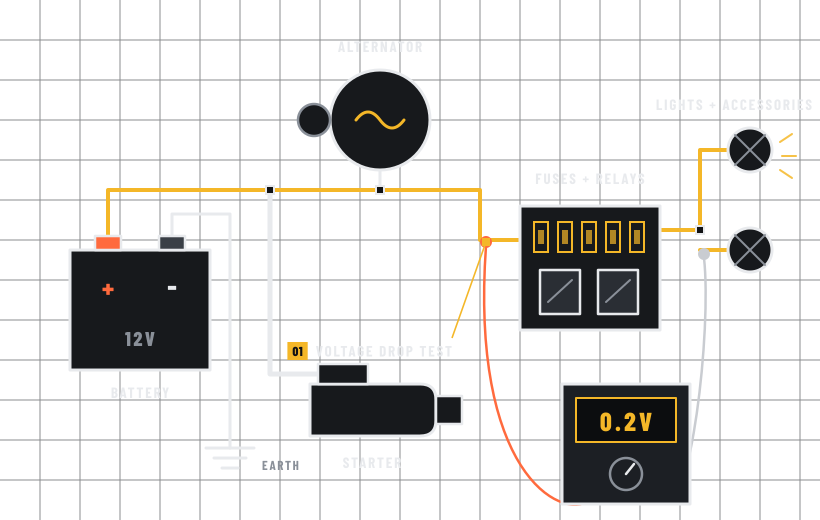
Voltage drop testing finds what a quick check misses. It measures how much voltage is lost across a connection, cable or earth path while the circuit is carrying its normal load. A corroded joint can pass a continuity check with the circuit off and still lose enough voltage under load to make a component misbehave.
Along the way, connectors get opened and inspected for corrosion, damaged seals and pins that have backed out or lost tension. Earths get checked at both ends. Previous repairs and add-ons get a hard look, because that's often where the problem started.
Fix the cause, not the symptom
Cleaning a green terminal and spraying it might get the machine going, but if the corrosion has wicked up into the wire, it will come back. The lasting fix is to cut back to clean wire, fit new terminals and seal the join properly.
Chafing is the same. Taping over a worn spot isn't a repair. Fix the damaged wires properly, re-route or re-clamp the harness so it can't rub again, and protect the area. Where a section keeps failing because it flexes or rubs all day, a braided harness can be a better long-term answer than more conduit.
How to prevent them
Prevention comes down to basics done properly, plus someone checking the known weak spots on a schedule. Adding electrical checks to a preventative maintenance program means those spots get looked at regularly, not only after a breakdown. These are the habits worth building:
- Install accessories properly: fused at the source, relays for heavy loads, sealed connectors, routed, clamped and grommeted.
- Keep a record of what's been added to each machine and where it's wired in.
- Check harness rub and flex points, earth straps and battery terminals at every service.
- Keep the pressure washer off connectors and looms.
- Fix small chafe points as soon as they're spotted.
- Get operators to report flickers and odd warnings early, while they're still easy to trace.
Get it found, not just reset
If a fault keeps coming back, it needs someone who'll take the time to find it. We do auto electrical fault finding on vehicles, trucks and machinery at your depot, yard or site across Newcastle, the Hunter and the Central Coast. Send us the fault history and operator notes before we come out. It gives us a head start.
Quick answers
Why does the fault disappear when someone comes to look at it?
Because the conditions that trigger it aren't there at the time. A connection that opens up when it's hot, wet or shaking can test fine on a cold, still machine. That's why notes on when it happens matter so much.
Should we just replace the part that keeps throwing the code?
Not until the wiring to it has been tested. A fault code tells you which circuit saw a problem, not always which part failed. The sensor can be perfectly fine while the connector or earth feeding it is the real fault.