

Key takeaways
- Braid usually comes out ahead where wiring flexes, rubs or vibrates.
- Neither copes with high heat without the right material and routing.
- Conduit is still fine in protected spots that don't move.
- Give a harness builder photos, connector details and the old harness if you can.
What we're comparing
Conduit here means the corrugated plastic tubing you'll find on a lot of plant and trucks, split or solid, with fittings where it meets connectors and junctions. It's cheap, easy to get, and most fitters know how to work with it.
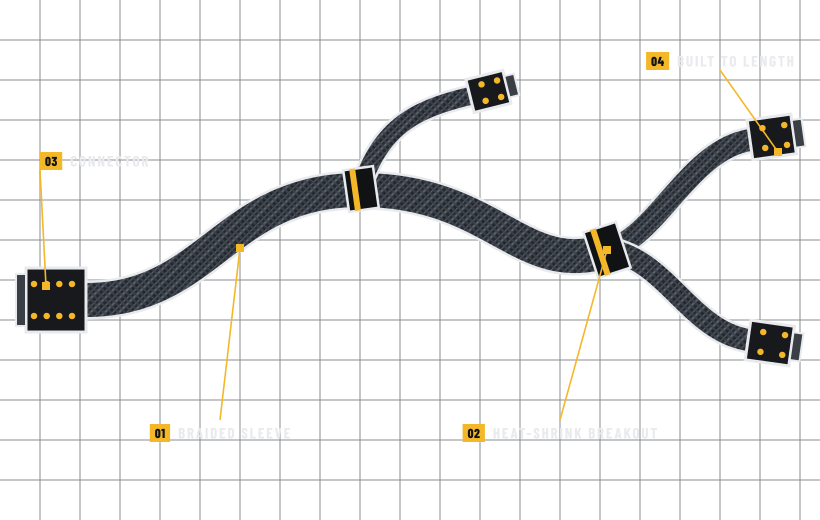
A braided harness is built as one fitted assembly. The wires are cut to length, bundled and covered in an expandable woven sleeve, with heat-shrink boots sealing the breakouts and connector ends. Built properly, it follows the machine's routing closely, without loose loops or spare tubing flapping around.
Abrasion and vibration
Rubbing and shaking cause a lot of harness trouble, and this is where braid has the clearest edge. A tight braided sleeve stands up well to rubbing, and wear shows up as fuzzing or broken strands you can spot on a walk-around, often before the wires inside are damaged.
Conduit can wear through at the ribs where it sits on an edge. Split conduit can also open up under constant vibration, letting wires work out through the gap and dust and water in. Fittings can crack or pull out on machines that shake all day.
Neither type fixes bad routing. Whatever it's sleeved in, a harness still needs proper clamps at sensible spacing and clearance from sharp edges and moving parts.
Heat
Be wary of anyone who says braid solves heat problems. Standard braided sleeving and plastic conduit both have limits, and both break down if they sit against an exhaust or turbo.
Near real heat you need sleeving made for high temperatures, heat shielding, better routing, or a mix of all three. Plastic conduit that has lived near heat for years also tends to go brittle and crack, and that's a good sign the wiring inside needs a look.
Flexibility, weight and looks
Braid bends easily and follows the shape of the machine, so it suits harnesses that move: articulation points, booms, cab tilts, doors and hinges. Conduit is stiffer, and it can kink or split on tight bends that flex all day.
Weight rarely decides it on heavy plant, because the difference is tiny next to the machine. Bulk matters more. A braided harness takes up less room, which helps in crowded engine bays, tight cable runs and ute fit-outs where space is short.
Braid also looks neater, and that's not just vanity. A tidy harness makes damage, heat marks or someone's unauthorised add-on obvious at a glance.
Serviceability: where conduit wins
Here's the honest downside of braid. Adding a circuit later means opening the braid or running a separate loom, and checking an individual wire means cutting back the sleeve and resealing it. With split conduit, you can open it up, add a wire and close it again quickly.
A braided harness also takes longer to build than a run of conduit, so it costs more up front. Whether it pays off depends on how often the old set-up was failing and what each failure cost you in downtime.
One way to soften the serviceability problem is to ask for a couple of spare wires in runs that are hard to get at. Then the next accessory doesn't mean opening the harness.
When conduit is still fine
Plenty of the conduit on your fleet is doing its job. Braid earns its place on harnesses that move, rub or vibrate, in tight spaces, and on runs where conduit keeps splitting or pulling out of its fittings. If one section of wiring keeps causing intermittent faults, that's a good place to start. Conduit is still a sensible choice for:
- Inside cabs, under dashes and behind panels, where nothing rubs and there's no heat.
- Short runs on fixed parts of the machine that don't flex.
- Accessory wiring you expect to change or add to.
- Runs where the conduit and fittings are sound and the fault was one chafe point you can fix and protect.
What to send a harness builder
We build custom braided harnesses with a quick turnaround, and we'll tell you straight whether braid is worth it on a given machine or whether a conduit repair will do. Either way, good information gets you a replacement sooner and a better fit.
If the machine can spare it, the old harness is the best sample of all. Otherwise, send as much of this as you can:
- Machine type, make, model and serial number.
- What the harness connects, and the route it takes.
- Photos of the full run, both ends, every breakout, and each connector face taken straight on.
- Connector part numbers, if they're printed on the connector or listed in the parts book.
- Measurements to each breakout taken along the route, not in a straight line.
- A wiring diagram or pinout, if you have one.
- What failed and where: chafe, heat, crush or corrosion.
- Nearby heat, fluids and moving parts, plus any extra circuits or spare wires you want added.
Quick answers
Can a braided harness be repaired in the field?
Yes. The braid is cut back at the damaged section, the wiring is repaired properly, and the section is re-sleeved and sealed. It takes more care than slitting open a length of conduit, which is another reason to get the routing and clamping right the first time.
Is braid worth it on a ute fit-out?
For the runs that move, often yes. Wiring that crosses the tailgate hinge or runs out to a canopy door flexes every day, and braid handles that well. Inside the cab, conduit or a neat loom is usually fine. Our fleet ute fit-out guide covers the rest of the wiring.
Can you copy a harness without a wiring diagram?
Often, yes, if we have the old harness or clear photos of both ends and every connector. A diagram makes the job quicker and helps us spot whether the old harness was modified along the way.